
Brooks County Court Records After Arrest
After a Brooks County jail arrest, booking happens first at Brooks County Jail, the local detention facility operated through Sheriff Mike Dewey's department. That jail entry may show the arresting agency, charge description, statute, warrant number, court label, bond field, and a status such as currently booked or released. Those booking rows are useful, but they are not the same as the court record. Formal Brooks County court records begin when a case is filed, an accusation is entered, an indictment is returned, or a matter is transferred to the court that will hear it.
Felony matters usually move toward Superior Court, while misdemeanor and traffic matters may appear in State Court or a municipal court. Magistrate Court is important early because the county court page identifies it as the local office for warrants and related first-stage matters. For custody and booking details, use Brooks County jail inmate records. For booking-photo questions, use Brooks County jail roster mugshots. The court record is the case side: filed charges, court events, dispositions, and copies kept by the clerk or court access system.
The Brooks County courts page lists the county court offices that make this split easier to follow.
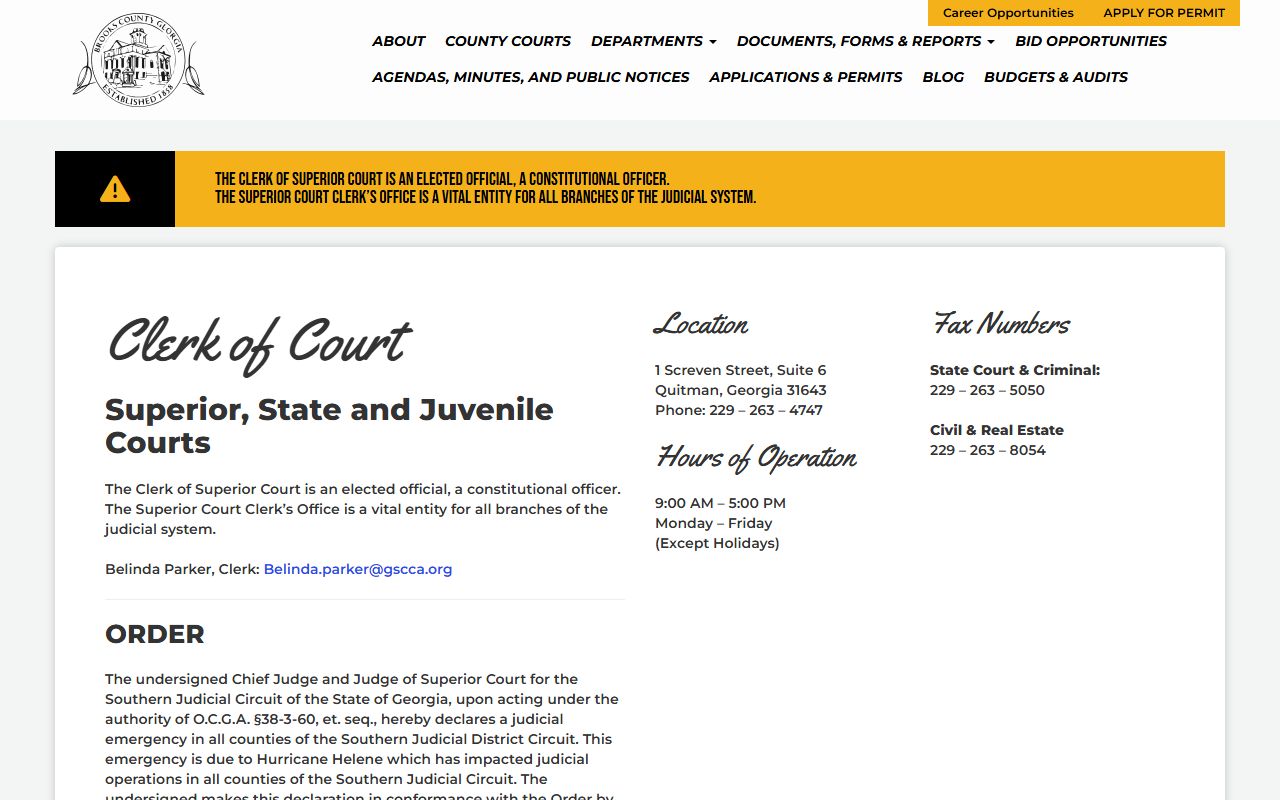
The court page is useful because the jail is on Holloway Drive, while court-record questions route to Screven Street court offices.
Find Brooks County Court Records After Arrest
Brooks County Superior, State, and Juvenile court records are handled through Clerk of Court Belinda Parker. The GSCCCA clerk profile lists the clerk at 100 Screven Street, Quitman, GA 31643, phone (229) 263-4747, criminal fax (229) 263-8296, and Monday through Friday office hours from 8:00 a.m. to 5:00 p.m. For online case access, the Georgia Courts e-access page lists Brooks State and Brooks Superior through PeachCourt or re:Search routing. Georgia Courts also notes that provider accounts are required to search court records, so online access may not feel like the free jail roster.
- Start with the jail roster entry. Copy the full legal name, arrest date, arresting agency, charge description, statute, warrant number, court field, and bond status.
- Use the court field to decide where to ask first. Superior and State matters point to the clerk. Warrant and first-appearance questions often point to Magistrate Court.
- Search the Georgia Courts e-access provider list, then follow the PeachCourt or re:Search path for Brooks State or Brooks Superior if the case type is covered online.
- If online access does not show the case, contact the clerk or use the public access terminal described in the Brooks County e-filing order.
- Keep the warrant number separate from any court case number. A roster warrant number is not always the case number used by the clerk.
The Georgia Courts e-access page is the statewide starting point for provider access.
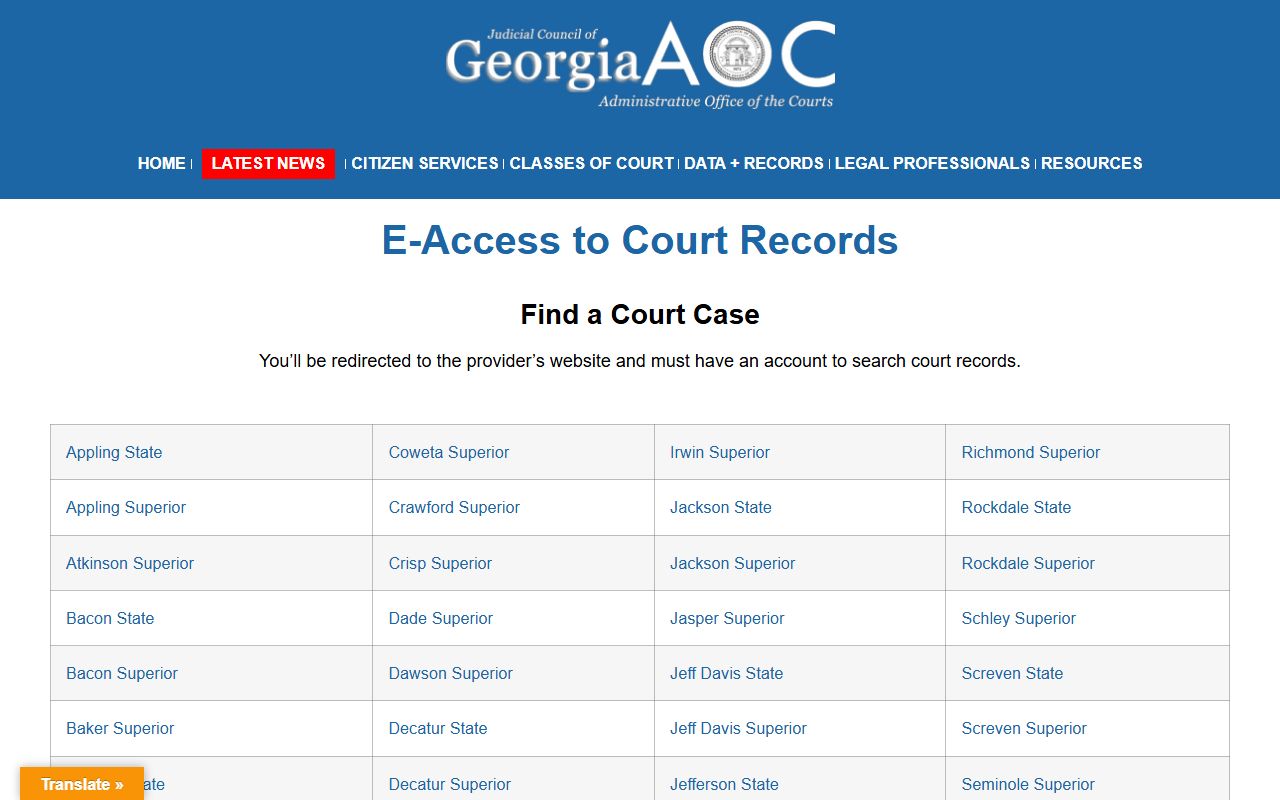
That provider-account step matters because jail booking data may be visible without login, while court records may require a provider account or clerk-office access.
| Access Field | Type | Required | Brooks County Notes |
|---|---|---|---|
| Georgia Courts provider selection | Provider list | Unspecified | Brooks State and Brooks Superior are listed through PeachCourt or re:Search routing. |
| PeachCourt account | Account login | Yes for online provider search | Georgia Courts says users must have an account to search court records through providers. |
| Clerk public terminal | In-person access | Not applicable | The Brooks e-filing order describes a public access terminal in the clerk's office. |
| Case number | Search field | Helpful if known | Use the court case number from paperwork or clerk correspondence, not just the roster warrant number. |
| Defendant name | Search field | Helpful if known | Use the exact name spelling from the Brooks County jail roster and court papers. |
Brooks County Arrest Charging Records
A Brooks County jail arrest does not end the charging process. The roster can show the arrest charge, but the prosecutor may later file a different formal charge, reduce a charge, add a count, dismiss a count, or present a felony matter to a grand jury. The Southern Judicial Circuit District Attorney is Brad Shealy. Research sources identify him as the District Attorney for Brooks County matters, and the prosecutor role is to review serious criminal cases and file or present formal charges when the law supports them.
| Document | Who Uses It | What It Does | Brooks County Context |
|---|---|---|---|
| Complaint | Officer, court, or prosecutor | Sets out the alleged offense at an early stage. | May be tied to Magistrate Court, municipal matters, or early case processing. |
| Information or accusation | Prosecutor | States the charge the prosecutor files without a grand-jury indictment. | Can differ from the jail roster charge after review. |
| Indictment | Grand jury | Formally charges felony counts found by the grand jury. | Often tied to Superior Court felony cases. |
State Court, Superior Court, Magistrate Court, and municipal labels on Brooks County roster rows should be read as routing clues. They are not a final legal outcome. When a case is new, the jail entry may exist before a clerk index shows a filed case. That delay is normal and should be checked with the clerk, Magistrate Court, or the jail, depending on the question.
Brooks County Charge Status
Charge status tells a different story than booking status. A jail status such as currently booked or released answers whether the person is in custody. A court charge status answers whether a count is still pending, changed, dismissed, or resolved by plea, verdict, or other court action. Brooks County court records after a jail arrest should be checked charge by charge because one count can be dismissed while another remains pending.
| Status | Plain Meaning | What to Verify |
|---|---|---|
| Pending | The charge has not reached a final outcome. | Next hearing, court assignment, and bond terms. |
| Amended or reduced | The filed charge changed after review or negotiation. | The current charge text, statute, and misdemeanor or felony level. |
| Dismissed | The charge was dropped by court order or case action. | Whether all counts or only one count were dismissed. |
| Nolle prosequi | The prosecutor chose not to pursue that charge. | Whether another count remains open in the same case. |
| Convicted or adjudicated | A plea, verdict, or final finding resolved the charge. | Sentence, probation, fine, jail credit, and appeal status if relevant. |
Note: A roster charge is an allegation or hold until court records show a final conviction.
Bond in Brooks County Arrest Cases
The Brooks County roster displays a Total Bond field. Research samples showed numeric amounts, NOT SET, and DENIED. The roster does not publish bond type, payment methods, bond-posting hours, or a full per-charge bond breakdown. That means the public field is a starting point, not a release instruction. Call Brooks County Jail at (229) 263-8153 before traveling or paying money, especially when a bond field says denied, not set, or when another hold may exist.
| Bond Type | How It Works | Brooks County Checkpoint |
|---|---|---|
| Cash bond | Money is paid to secure release and court appearance. | Confirm amount, payment place, and hours before arrival. |
| Surety bond | A licensed bonding company secures release. | Ask whether the court order permits a surety bond. |
| Property bond | Property is pledged where court rules allow it. | Verify local court acceptance and paperwork. |
| Own recognizance | Release is based on a promise to appear. | Only applies if the court orders it. |
| No-bond hold | Payment alone will not release the person. | Check for a denied bond, detainer, probation hold, or other agency hold. |
Warrants Behind Brooks County Arrest Records
No public Brooks County sheriff active-warrant search portal was located in the research. When a warrant has led to booking, the jail roster may show a warrant number, count, statute, charge description, court, and bond or hold status. For warrant questions before or after booking, Magistrate Court is the key local contact because the county court page lists warrants among its functions. Magistrate Court is at 100 W. Screven Street, Suite A, Quitman, GA 31643, phone (229) 263-9989.
- Arrest warrant
- A court order allowing law enforcement to take a person into custody.
- Bench warrant
- A warrant issued by a court, often after a missed hearing or failure to appear.
- Search warrant
- A court order allowing a search, not a public custody record by itself.
- Detainer or hold
- A request or order from another agency that can keep a person in jail even after local bond is addressed.
Formal cases tied to warrant arrests should be checked with the clerk once a filing exists. Municipal court labels on the jail roster, such as Quitman Municipal or Morven Municipal, may require contact with the city court or arresting agency as well as county offices.
Charges vs Convictions in Brooks County
Being arrested, booked, or charged in Brooks County is not the same as being convicted. A charge is an allegation that begins the case process. A conviction requires a guilty plea, verdict, or final adjudication. This distinction matters for employers, landlords, families, and record seekers because a jail roster entry can remain visible in some form even when the court result later changes.
| Point | Charge | Conviction |
|---|---|---|
| Stage | Filed or listed allegation after arrest. | Final finding, plea, or verdict. |
| Proof level | Based on probable cause or prosecutor filing. | Based on proof beyond a reasonable doubt or a valid plea. |
| Where checked | Jail roster, warrant papers, clerk case record. | Final court disposition and sentence record. |
| What can change | May be amended, reduced, dismissed, or not pursued. | May carry sentence, probation, fine, or appeal information. |
Restricted Brooks County Court Records
Georgia public-record law favors access to public records, but it does not make every arrest, jail, or court file fully public. O.C.G.A. § 50-18-70 defines public records broadly, while O.C.G.A. § 50-18-71 covers access timing and allowed costs. O.C.G.A. § 50-18-72 lists exemptions, including law-enforcement and pending-investigation limits. Juvenile matters, sealed filings, restricted criminal-history material, and some dismissed or sensitive records may not appear in a public search result.
| Point | Sealed | Expunged or Restricted |
|---|---|---|
| Public view | Hidden from ordinary public access. | Removed or restricted from routine public release where Georgia law allows. |
| Agency access | Some court or law-enforcement access may remain. | Access may still exist for limited legal or agency purposes. |
| Common trigger | Court order, juvenile status, protected filing, or statute. | Eligible dismissal, disposition, or restriction process. |
| What to do | Ask the clerk what public access is allowed. | Use the proper court or criminal-history restriction process. |
Brooks County's open-records policy says requests may be made by phone, in person, mail, fax, online, or email, and written requests are preferred. The policy describes a three-business-day response process and explains that the county reviews whether records exist, whether exemptions apply, and whether fees are due. For county public-record requests, the policy lists publicrecords@brookscountyga.gov, and County Clerk Patricia Williams can be reached at (229) 263-5561.
Brooks County Prosecutor and Defense Contacts
The Southern Judicial Circuit District Attorney, Brad Shealy, is the prosecutor identified in Brooks County criminal-source research. Felony and serious criminal matters may be reviewed by that office before an accusation, indictment, plea, dismissal, or trial setting appears in court records. The 2025 Southern Circuit service list gives the District Attorney phone as (229) 333-5291 and fax as (229) 245-5403.
Defense access matters too. The Georgia Public Defender Council lists Brooks County in the Southern Circuit with Wade Krueger as circuit public defender. The main office is at 1905 N. Patterson Street, Valdosta, GA 31602, phone (229) 333-5293, fax (229) 333-5312. Public-defender eligibility and appointment are tied to the court process, income screening, and case assignment.
Important: Public court data is not a consumer report and must not be used for FCRA-covered screening decisions.